
“Farewell to spring.“
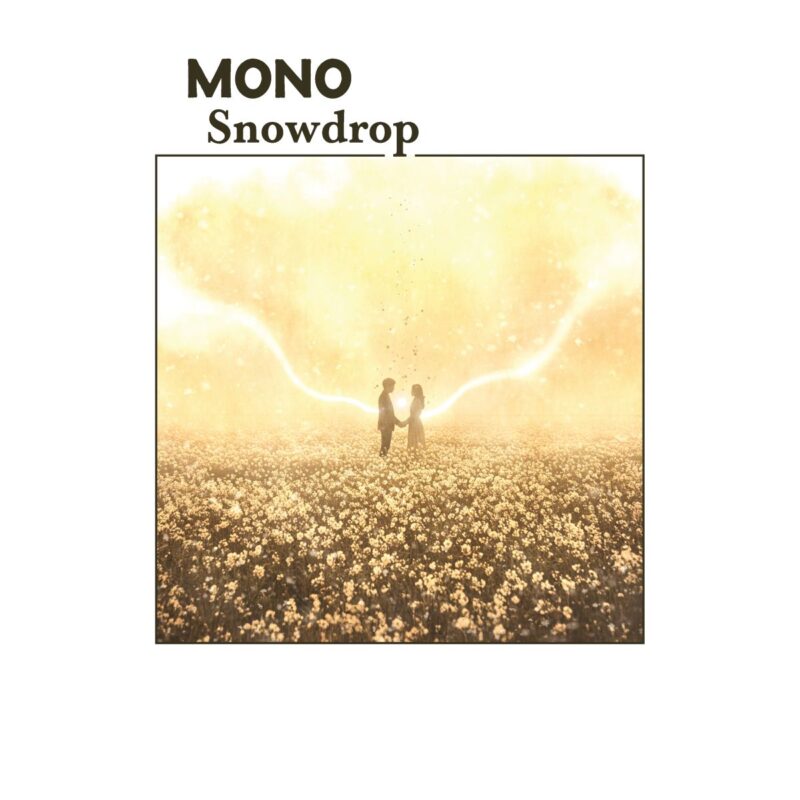
There’s an unshakeable sense of loss hanging over Snowdrop, the first album Japanese instrumental luminaries MONO have made since the passing of long-time producer Steve Albini, the quartet’s go-to for the previous decade. That partnership stretches back to 2004; For My Parents & The Last Dawn/Rays of Darkness aside, he’s been a vital part of shaping their sound for much of the past 22 years. The team-up on Hymn to the Immortal Wind in 2009 resulted in arguably their best-loved record and a springboard to dizzying highs. His untimely death in 2024, mere weeks before the band issued OATH, came between lead guitarist Takaakira Goto losing his father and father-in-law. Loss is never easy and grief isn’t a straight line, so the version of the band presented to us in 2026 is every bit as celebratory as it is mournful, yet always moving, in multiple senses of the word.
That sense of forward motion, overseen this time by Brad Wood, is compounded by the addition of a 10-piece orchestra and 8-piece choir, yet those auxiliary elements add colour and contrast to the base elements of the Tokyo band’s established sound, rather than overshadowing it. They can sound exactly as massive or restrained as they want, as the title track oscillates wildly between both extremes for an immediate example of the band at their blustery best. In context, the rock-forward sound explored on “Winter Daphne” is an inversion of what many have come to expect from the band, while penultimate track “Bells of Ireland” makes admirable use of the space afforded by a sparse arrangement; that orchestra is present but rarely steals the spotlight.
That a minimalistic approach offers one of the more compelling moments on the record is surprising, particularly as the band seem to revert to type elsewhere. There’s plenty you have to do, and do well, to stand out in a field this crowded, and the band have earned their plaudits many times over as they close in on 30 years together. In that time, they’ve only changed personnel once; original drummer Yasanori Takada stepped away in late 2017, and Dahm Cipolla filled that space the following year. His performance on the instantly memorable “Shion” serves as one of the record’s highlights, significantly upping the tempo in contrast to the rest of the album and making its presence felt as a result. A sense of groove in the midst of an emotionally weighty 50 minutes helps it stand out, a mid-album pickup that is nonetheless shot through with emotion.
The unified mood explored across these eight songs somehow acts as both Snowdrop’s biggest strength and glaring weakness. MONO try to be, well, MONO, almost to a fault, presenting an undeniably affecting record that cuts through at its most melancholic moments, such as “Hedera“, or the band sounding absolutely locked in on “Gerbera“. It does get bogged down more than a little by predictability, however; almost as though they wanted to stick to what they know and rally around familiar patterns in the wake of loss. Viewed through that lens, much of the movement and writing here becomes instinctual. Don’t get us wrong: nothing about it suggests a band on autopilot (listen to how they stick the landing on “Farewell to Spring“), but retreating to tried-and-tested methods results in an album that loses its sparkle on repeated listens. Judged on its own merits, Snowdrop fares far better; no doubt live renditions will hit a lot harder. Their concert reputation speaks for itself. Maybe file this one away for the winter.