
“A lost impression calls to me in a hidden memory.”
Music takes you to spaces in far more ways than via visual accompaniment. There are obvious cases where the cultural link has been defined again and again, such as country and folk music. Even if you can’t see the album cover of a punk or emo album, one can’t help but envisage a cramped collage dorm show, or a poorly attended yet still sweaty pub venue. Music that invokes the qualities of prior decades brings a hauntological quality, for better and often for worse. Even the blandest of bland radio pop takes you somewhere – the consumable ‘everywhere’, an uncanny mallscape with one goal: to make you more susceptible to pulling out your wallet. Metal has always had a particular penchant for pulling the listener into a physical space, whether that’s the long-running obsession with sci-fi and fantasy or the unashamed embrace of cheese. This escapism is an undervalued part of its weave, interacting with all its aesthetic elements and creating a breadth of experiences from the same set of amps, microphones, and drums.
REZN are one of the most prolific artists in modern doom, and they have dedicated their discography to sonic soundscaping. Each of their releases maps to a realm or biome, with some elements that are physical and others fantastical. In their nine years as a band, they’ve released almost as many albums and collaborations, and in the process have crossed oceans, deserts, mountains, rivers, and more. Their fundamental elements have been locked in since their debut record, Let It Burn, in 2017. The bedrock is the typical bass/drums/guitar power trio that underlines all doom metal – Phil Cangelosi on bass, Patrick Dunn on drums, and Rob McWilliams on guitar and microphone – with the addition of Spencer Ouellette on synth and saxophone, creating all the embellishments their sound needs in a fully ‘live’ way.
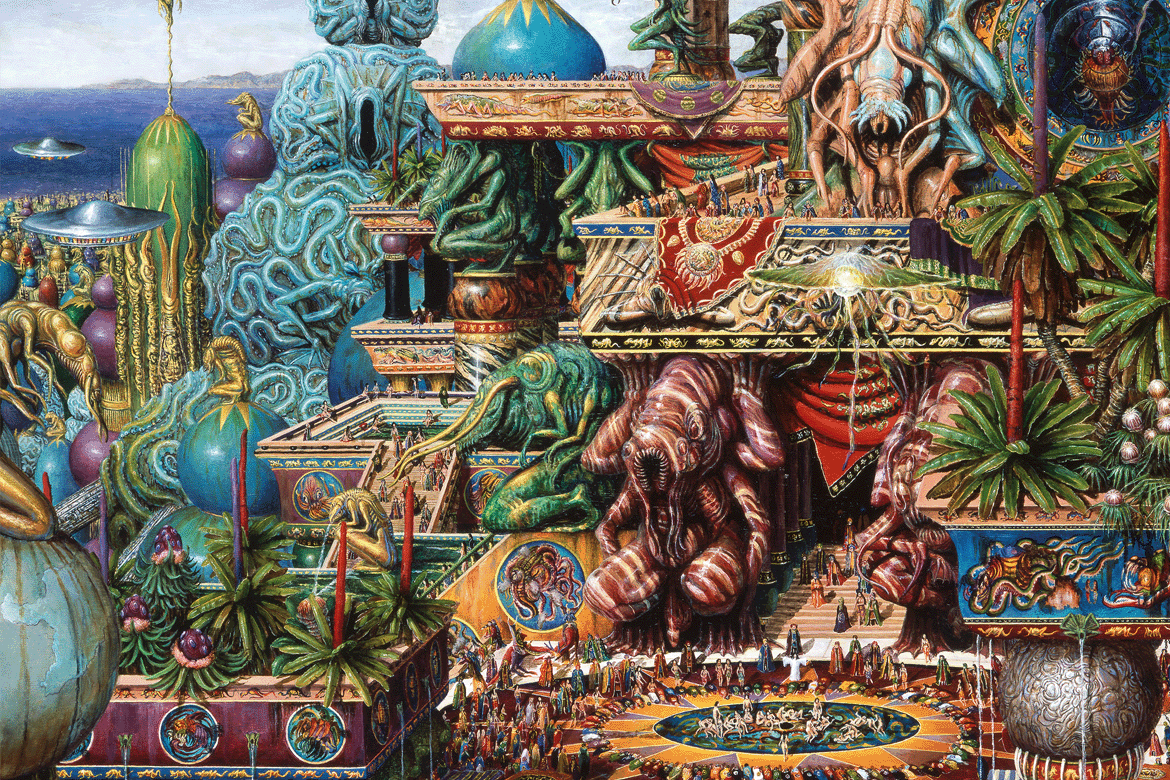
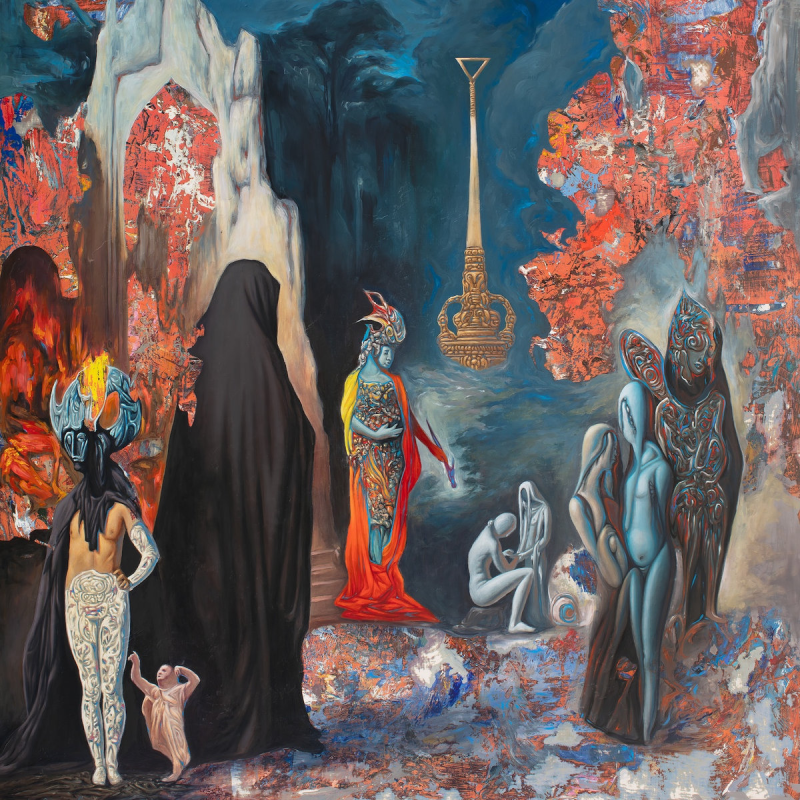
For their 2026 record, there is a theme change that creates a tangible difference for the band, yet represents their style in the most REZN way possible. No longer do they strive to conjure a physical space: Cycles in the Infinite Dream is about the mind’s dreamscape, representing all its tribulations and tranquillity. This shift necessitates a change in artwork duties, enlisting Jacques de Beaufort to make a tremendously fitting dreamlike visage for the album. Even without this ‘hint’, longtime fans will notice the intent of the album subtly turns toward something more ephemeral and intangible.
REZN‘s songwriting chops are at their usual high quality level here. Thus, much of the change on Cycles in the Infinite Dream has occurred with its production. In an effort to create a more spacious, democratic sound, the guitars take a step away from the limelight. Typically the heralds of any heavy psych sound, a now a gentle change comes for the guitar and bass sounds compared to prior albums, especially compared to the hefty Burden. This yields a very different mood. Cycles in the Infinite Dream is still a very heavy album, as evidenced by pieces like “The Vessel”, “Transient”, and the intense highlight, “Primal Thread”’s dissonant and spiralling bridge. Yet the heaviness is told through more than just volume. The riffs are more dogmatic, repeating with intent and newfound simplicity, imparting a steady and determined weight. If there’s noticeable distortion, you feel it in the bass, particularly on “Transient”, or as the soundscape falls away and chords ring back into the speaker cabs. Within the concept of the album, the heavy moments feel like frantic REM cycles or episodes of sleep paralysis, where one fights back their own thoughts to let the synapses take the wheel towards the realm of dreams.
The space that’s vacated is used to create the dreamscape of Cycles in the Infinite Dream. Never before in REZN’s work have McWilliams’ vocals been so front-and-centre. His voice is among the ultimate for that ‘nasal’ doom vocals, sung the way Ozzy intended. Much like their contemporaries in Monolord, YOB, and Green Lung, this style gives the music dramatic lift. In the process of highlighting the vocals, we get pieces like “Cloudfall”, which becomes the most immediate track of their catalogue, with its powerful chorus refrain that encapsulates the album (“more than a dream / if only you could see”).
Much of the rest of the room is occupied by Ouellette’s various gadgets. Where other bands treat additional synthwork as a studio-only or backing track featurette, REZN decided this would be their priority from the very beginning. As such, Ouellette has been a defining part of the band, bringing something to each track that sets them apart from many other metal projects. If you want quantitative proof of this separation, Ouellette’s interview with Ableton is the only article on Ableton’s blog tagged with ‘metal’ – a distinguished honour from what is typically considered ‘software for electronic music’.
If ever there’s been a mainline REZN album that is Ouellette’s playground, it’s Cycles in the Infinite Dream. From the panicked saxophone on “Transient”, to the chaotic swells of electronics that accent every loud moment. A new inclusion is lap steel guitar – its inclusion being a strong tell for the extent to which this record is ‘laid back’. On “Escher”, an already unusual post punk groove is inversely complimented with lap steel guitar à la David Gilmour. The playing is sublime, and these disparate styles and track’s title project an impossible landscape into the mind, one that’s still idyllic despite all the colliding spheres. The lap steel also a subtler part of the sonics on “Cloudfall” and the record’s last moments with “Terra Petra”, becoming a core sonic touchstone for the record.
Perhaps most importantly for Cycles in the Infinite Dream, some of the space created by the gentle pull-back of the guitars is not filled at all. This ‘lack’ is essential to the album, turning ‘breathing room’ into ‘dreaming room’ in a way practiced by choice acts like maudlin of the Well and Alcest. This space is literal on the lovely interlude “Devotion”, but also tangible on all the tracks, light and heavy. This time around, less really is more for REZN.
Cycles in the Infinite Dream is significant within REZN’s discography for its laid back yet intense, kaleidoscopic style. Those coming to the band for the first time, or simply casual listeners who don’t attune to the record, may not find it to be a significant departure from their prior work. It’s true that these changes are just nudges, emphasising different qualities rather than taking anything truly away from their core sound. Within the concept of dreams, there was an opportunity to make something truly weird, especially given the potential breadth of REZN’s style. Perhaps that’s a move that is forthcoming for the band, but for now, Cycles in the Infinite Dream can stand among their strongest records and subtly lead the band towards new pastures.