
“You found in their night sky your same world.”
It is difficult to discuss the Swedish summer without slipping into stoicism. The country turns absolutely idyllic as the forests, fields, lakes, seas, and even cities become resplendent. It’s almost never too hot, and every natural water source becomes a beckoning lagoon for bathing. But this short-lived beauty is enjoyed with the long, dark winter held in mind. Summer is something you have to make the most of whilst it’s present, as it might pass by in the blink of an eye. You must dive into that water even though it’s still briskly cold; hold that crayfish party whether you’ll be rained on or not; sing “Små Grodorna” around the maypole, because who knows if it might be the last time. Nature might be picture-perfect, life is not.
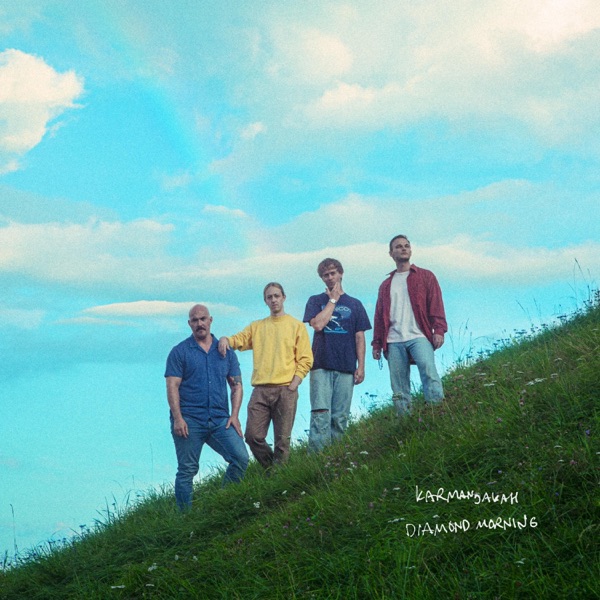
If every other thall band is the winter, Sweden’s Karmanjakah is exactly 8pm on the sunniest July 31st of your life. They’ve built their name on taking technical metal to its most upbeat extremes, with the term ‘happy thall’ coined in their name. The band matches their sound with their visuals, declining the endless grit of 2020s heavy music for dressed-down golden hour analog charm. In true Scandinavian style, they have not rushed to put out their discography or exhaust themselves on the live circuit. Their first EP was ten years ago, with a second EP and an LP in the intervening years. Diamond morning now comes after a four-year gap, hotly anticipated by their global listeners, and justifies their careful approach as it immediately becomes their magnum opus.
Opener “Dove” was the single that started this cycle and continues to be an incredible start for the record. The first sign of their sound expanding are the flashes of blackgaze, fitting naturally into their dreamy sound, a technique they return to several times on the album. What’s also apparent is that “Dove” is the most ‘normal’ track on the album in terms of Karmanjakah’s typical structure and sound. This album is not about stringing together ten typical four-to-six minute tech songs, as “Eyes seeing eyes” immediately proves. It’s more piano driven than guitar oriented, still leaning on them for impact but coming back to roost on muted keys. It’s a fantastic start to the album that emphasises Karmanjakah’s ambition to be light as a feather and as heavy as an anvil. The lyrics wield this double-edged sword, too, balancing images that are fragile and bold, and always reflective (“The sound of the leaves flickering in your chest / The million deer released when you say the words”).
But if you want those heavy moments, Diamond Morning delivers in spades. “Thousand horns” is a huge track with even bigger dynamics in tempo, book ended by intensity and elsewhere holding its chords with majesty. A key characteristic is that the record is largely ‘tech’ by association to thall and djent styles, not by way of actual fast playing – flexing talent would create the opposite effect on a record such as this. Title track “Diamond morning” is soaked in synths and choirs, closing with a big, djenty, ‘classic Karmanjakah’ riff that will get crowds headbanging like a wheat field in the breeze. “Sun, astray” must be a classic track for the band, providing a dual hook with a simple chorus melody on both lead guitar and vocals. A little post-chorus guitar solo is a nod toward rock and roll sensibility, but from there the track finds its own unique course. Verse two crescendos into just acoustic guitar and Lundruist’s call, a moment that sucks the air from your lungs.
Karmanjakah have carefully meditated on the structure of Diamond morning. The smooth transitions between twinned tracks like “Sun, astray” and “Moon, astray” and the “Diamond” suite that close the record are the obvious examples, but every track bleeds into its neighbour. The record’s structure surprises time and time again, not just flipping between light and heavy. Stacked interludes and highly dynamic tracks are an absolute delight in the landscape of 2026, where so many artists fall short on pacing their records, despite their progressive tendencies.
And speaking of interludes, these are some of the best you’ve encountered in the metal world (if this record even resides there). “Moon astray” is a continuation of “Sun, astray”’s acoustic bridge, one that will enchant fans of Cloudkicker’s Let Yourself Be Huge. It’s the album’s first drawn out moment, creating a moment of tension despite its friendly sound. A guitar solo noodles softly for two minutes, pointedly declining to take the spotlight. Yet just as you think the whole piece is wrapping up, Karmanjakah injects another unexpected turn with a rap flow from Lundruist. Such elements have always been divisive, but the approach uses just acoustic guitars and is beatless (no overdone trap beats to be found). The part presents Lundruist confident, yet alone, allowing him to clinch many satisfying lyrical turns. Later “Diamond Art” pulls the same trick, impressing with “No rope to throw over to the holy ghost side / I don’t know why / If only I could open those blind folded comatose eyes”.
“Sapphire” is an especially inventive interlude which turns its djenty groove into a jazz pattern in a heartbeat. You can feel the warm smiles on their faces as they put this together in the studio, watching drummer Sebastian Brydniak play the snare like he’s spreading caviar over Knekkebrød. “Ruby” is the only short piece you’d expect to hear on a Plini or Devin Townsend record, a pure guitar track full of cosy harmonics.
The story of Diamond morning is not limited to feelgood sensibility. “Diamond train” is ostensibly upbeat yet emotionally uncertain. Although the chorus brings biting clarity, the bulk of the track bounces between two chords that don’t have a strong resolution, particularly the ending which leaves a lasting impression as the record’s finale. The lyrics run parallel to this unresolved sensation as they ponder the way that life runs through our fingers (“the diamond train is still carrying you forwards… neither do those who you meet here know when to alight”). As this big riff churns for the ending, each musician hangs up their instrument in turn, leaving just drums making the last hits of the album.
Releasing in early May, Diamond morning is poised to be the tech soundtrack to the summer. It contains boundless beauty in its performances and makes surprising and successful choices throughout. Yet it also invokes the ephemeral nature of the seasons, through lyrics that embrace vulnerability and uncertainty, and through a variety of musical ideas that don’t often take the easy road. Like summer in the band’s home city of Stockholm, this record may feel fleeting – indeed, it’s a track shorter than A Book About Itself. But even this aspect feels deliberate, as the band keeps from repeating themselves across its runtime, never once including a merely ‘average’ Karmanjakah song. It’s yet another way that Diamond morning calls the listener to embrace the ephemerality of life, not because a winter waits in our future to snuff it out, but because that’s what living looks like.