
“You retreat in time and space.“
Let’s begin with a little gatekeeping: ambient music is under siege. It’s especially susceptible to corporate greed and slop, as highlighted by the ‘Perfect Fit Content’ approach that Liz Pelly’s Mood Machine brought into harsh light. But even before this, there was a creeping malaise: the vibes-ification of the genre. The function and aesthetic of ambient music has become its beginning and end; artistic process and merit reduced to a mere morsel. The ubiquity of buzzword playlists and ‘beats to study to’ streams allows listeners to go on autopilot and remain unchallenged, and platforms relish the “high engagement” results, giving them no incentive to challenge their users. In turn, artists are forced to optimise towards banality in their sound, and eye-watering volume in their output.
Perhaps audiences can’t be blamed for searching for “baby nap time piano” instead of “less weird Aphex Twin”, but artists are certainly at fault for giving into the creative bankruptcy of ‘lo fi’ styles. For a moment in the 2010s the vaporwave movement might have been poised to revive the genre. Whilst a few classic albums (such as Birth of a New Day, I’ll Try Living Like This, and 아버지’s Reflection) were produced in the process, many agree it was a missed opportunity that didn’t break into the mainstream. There are many compelling electronic projects that are no-holds-barred explorations of sound: Onoethrix Point Never, Tim Hecker, Fennesz, Burial, and Autechre are all thoroughly active and gloriously irreverent, proving that there are still sonic boundaries to be conquered. However, there’s good reason that the absolute titans of the genre remain unfelled, still compelling even as their discographies gather dust.
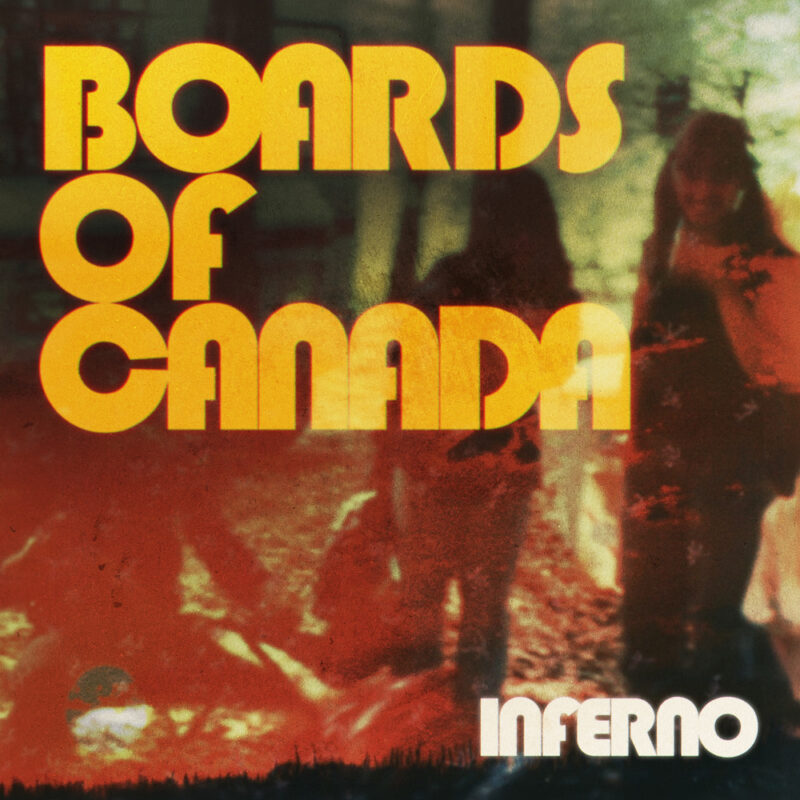
Boards of Canada have garnered respect and momentum since their work truly got going in the mid 90s. It’s worth invoking ‘hauntology’ when discussing their sound; even in their early years they were both forward-thinking and nostalgic. Using their roster of pre-decayed synths and beats, they created music and junctures in time and space. Key features of the project are a sensation that each moment is handcrafted, full of coincidence and wonder, and that things are never overstuffed or lost to looperism. The legions of electronic musicians of today, whether involved thanks to genuine inspiration or simply easy access to DAWs, should all acknowledge Boards of Canada’s influence on the genre – even the band’s own biography calls their sound “heavily copied”. Every one of their LPs is a timeless classic, each with its own character and atmosphere. Today is the first in thirteen long years since a new record has landed, and Inferno is certainly a captivating new chapter.
The overture “Introit” is Boards of Canada’s “fuck yeah, we’re back” – an arpeggiating synth with that production style, providing a chipper opening that could take the record anywhere. The uninitiated will be quick to compare it to Kyle Dixon & Michael Stein’s soundtracks for Stranger Things, not realising that the cultural memory of warped 80s VHS music is, by now, largely preserved through Boards of Canada’s music itself. The subsequent single “Prophecy At 1420 MHz” was thoroughly dissected upon release, somehow possessing every facet of the project’s sound at once. The joyous Boards of Canada-isms include the snarl of the synth strings that roam around the edges of the mix; the deep sampled voices which feel alien and gratifying; and the lurching drums, which rely only on simple tricks to craft memorable turns. To begin with, the track makes for a strong parallel to “Reach For The Dead” with its evil intent, but as the beat-driven part ebbs away, we’re left with a pleasant aftermath.
The first half of the record brims with similarly high quality pieces. “Hydrogen Helium Lithium Leviathan” also picks up where Tomorrow’s Harvest left off, feeling sparse and ephemeral. All its synths will be immediately familiar to the fans, having popped up in the band’s discography somewhere or other. Another immediate classic is “Naraka”, which begins with the simple pleasures of tambourines, then uses a Hindu chant sample in its second half to create a slice of paradise. For a throwback to The Campfire Headphase, “Into The Magic Land” is guitar focused yet dabbles in darkness, cohesive with Inferno’s overall atmosphere. There’s a spaghetti western quality to it, as if a desert mirage has swept into a half-lit saloon.
Undoubtedly, Boards of Canada are operating in their post-Geogaddi style, with thoroughly focused songwriting defining their approach to each piece, often letting samples take centre stage. “Age Of Capricorn” has some all-timer samples that harken back to their best, such as “1969” and “Sixtyten”. The way these samples converge and become the melodic driver of the track is perhaps unheard within the project. Similarly, “Father And Son” and “The Word Becomes Flesh” emphasise the wonky qualities of the band whilst bringing these samples to the front and centre. It’s so sample-oriented that the music practically steps out of the “instrumental” category – the voices are chopped into real hip hop flows, alternating between lucid and lurid.
These tracks are set to be controversial in the context of the band. Never before have the samples been so clearly in the spotlight. They’re processed in a way that optimises for rhythmic quality, entwining them within the track on a fundamental level. This is compelling in its own way, yet strikes out from the project’s prior approach, which, more often than not, allowed samples to be generally indifferent to the rest of the soundscape. At least some spontaneity of the band’s early discography is lost in this process as the tracks bend around their samples, and the listener is led more towards interpreting the voices than ever before.
As respected as the project is for its rhythmic pieces, Boards of Canada once again shine in the moments that are beat-free. “Acts Of Magic” stitches together three or four synth patches that have seemingly gone wrong, bleeding straight into “Memory Death” which elongates vocal samples for something more heavenly. “Somewhere Right Now In The Future” brings us back to glorious oddball energy as its melodic lines, guitar and synth, move in perfectly dissonant opposition. “Deep Time” bubbles with Tomorrow’s Harvest-esque euphoria with its subtly science fiction synths, though its mini orchestral swell is unfortunately corny, bordering on dungeon synth. As ever, these moments are striking because they set the mind pondering: what compels anyone to sign off on these cutting room floor titbits? Boards of Canada‘s talent for turning unexpected detritus into a cohesive sonic world has not worn off.
Having said all this, there are several tracks where Inferno‘s fire does not burn so strongly. “All Reason Departs” does not deserve to be the longest track, let alone have its own overture in “Deep Time”. It fumbles as it tries to crescendo and then gets locked into a middling groove, though the Autechre-esque variations to the synths are somewhat intriguing. “Blood In The Labyrinth” starts promising but misses fairly hard with a sitar sound, which feels crass sound next to Boards of Canada’s typically sublime selection of textures.
The second side of the album is not flawed, but it is less memorable. Pieces like “Arena Americanada” and “You Retreat In Space And Time” feel serviceable but not invaluable. Perhaps by now the key tricks of Boards of Canada’s style have been exercised, resulting in more of a victory lap. The project is not renowned for its album closers – of course, their style isn’t seeking a triumphant ending – but “I Saw Through Platonia” fails to recreate the magical ambiguity of prior endings, such as “Semena Mertvykh” or “Corsair” (let’s not count “Magic Window”). There’s also a general lack of attention grabbing samples at this end of the record, with exception for “The Process” which makes for a very compelling ambient piece. Maybe there’s been a deliberate omission by the band to make the back end more low-key, or to meet their conceptual vision (something that’s already been over-speculated elsewhere, based on the choices of samples). But as all their prior records have cult favourite tracks appearing late in their runtimes, it’s hard to say this decision doesn’t make for a real flaw.
As the gaps between their records have become scarily long, most Boards of Canada fans had likely given up hope that the project would meaningfully continue. As such, it’s hard to imagine almost anyone will be disappointed by Inferno. The highs are as high as ever within an already fantastic discography. There are some small imperfections, but many will love the extended runtime and tongue in cheek sampling approaches. In terms of character, it’s a marvellous cross between the doomed atmosphere of Tomorrow’s Harvest and Geogaddi’s big track-small track structure. Perhaps most importantly, the overall production of Inferno feels honest. It’s the glossiest release by the project yet, and realistically, in 2026, that couldn’t have gone any other way. But, unlike the lo-fi pretenders, it’s not been artificially retrofied. As the grip of nostalgia shows no sign of loosening on popular culture, it’s great to know that Boards of Canada are unbothered, still crossing the past, present, and future like none have done in the last thirteen years.