
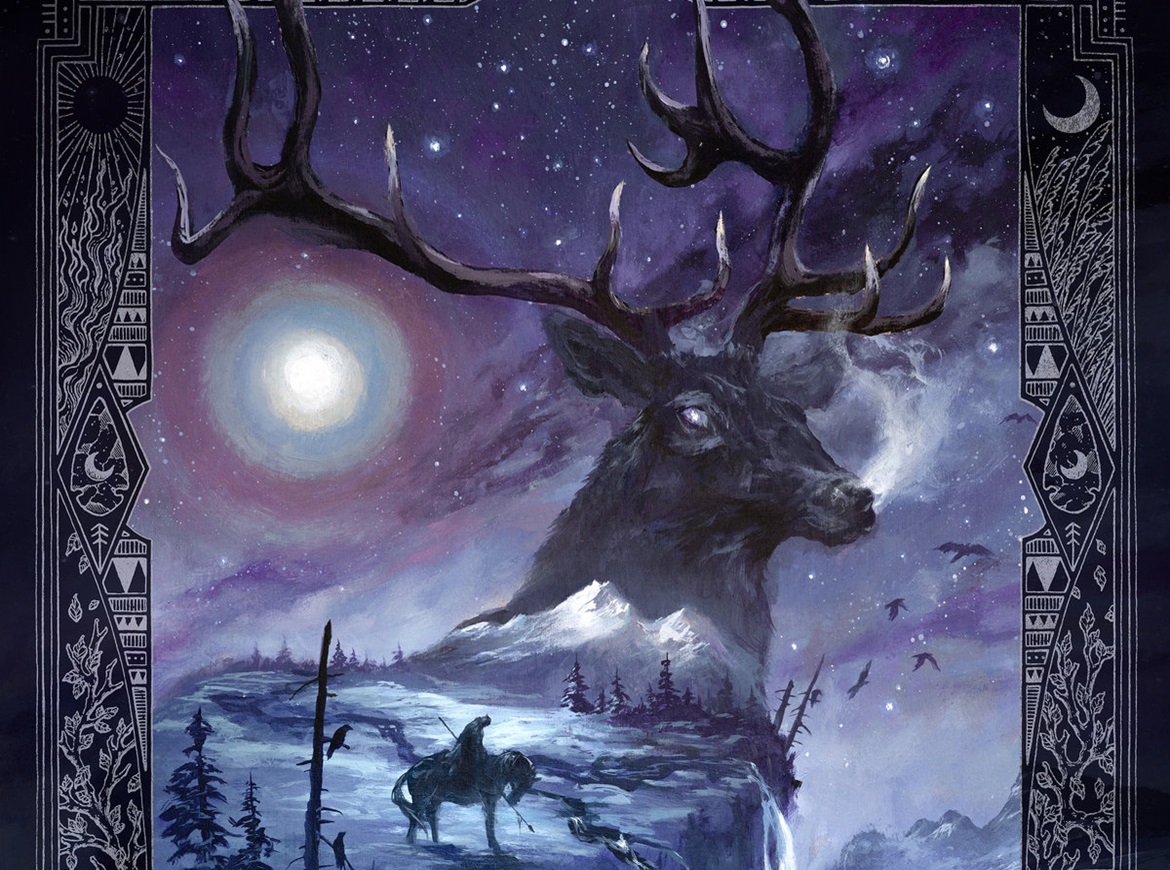
“The honor of a death steeped in beauty.”
The persistent strife of indigenous people throughout the world is unfortunately not uncommon. Conquest has uprooted the fabric of enduring lineages for as long as humanity has been around. Yet despite all of that, resolve ultimately prevails.
The vitality of heritage, connection to nature, and mysticism have enshrouded the Native American black metal scene in an atmospheric veil for nearly two decades. From Nechochwen to Ifernach, this growing niche has been around for quite some time, albeit to a lesser extent, until very recently. Lone-wolf project Blackbraid emerged from the vast wilderness of the Adirondack Mountains in 2022 and has been steadfast in making forgotten aboriginal voices heard. With two critically acclaimed releases under his belt thus far, Sgah’gahsowáh (Jon Krieger) has arguably been the eternal blackened inferno that has cast a shining light on the concealed memory of primeval struggle. On his latest allegory, Blackbraid III, Sgah’gahsowáh hones every facet of his ancestral vigor with a collection of aurally melancholic tales that is just as spiritual as it is wrathful.
Blackbraid III, like both of its predecessors, is meant to be consumed wholesale. Nothing is standalone, and every track connects seamlessly. True to Sgah’gahsowáh’s signature craft, each passage is compartmentalized between reprieving interludes that give the feeling of a single epic song, aligning with the spasmodic structure of Native American fables. From life to death, to life from death. Blackbraid III’s heavier entries thematically concern the final moments of existence, whereas its ambient respites are parallel to the first steps of reincarnation. Renewal is a cornerstone aspect of not just indigenous culture, but the primary focal point of Blackbraid III that is manifested through the record’s pace and philosophical centerpiece.
Black metal is reputably imperfect from a production standpoint, and in most cases, that’s where it remains engaging. The echoes of Hell are meant to be jagged and raw; it’s an inherent expectation for not only the genre’s most hardened proponents but transient listeners, as well. Yet, not only with Blackbraid, but Native American black metal en masse, the soulfully angry resounds of a proud race would be cheated out of maximum impact with a standardized approach to sound quality. Blackbraid III integrates a uniquely crisp means of production that serves as a fresh rarity for the genre. Whether it’s Sgah’gahsowáh’s blood-curdling screams or the foreboding whales of his instrumental work, every second of Blackbraid III evokes the long-winded pain and triumph of those who have felt the brunt of exploitation for centuries. It’s no secret that thousands of years of cherished history flow through the auditory veins of Blackbraid’s short but vastly effective body of work. With a coating of sonically polished war paint, Blackbraid III is the flaming arrow that has followed Sgah’gahsowáh’s previous warning shots.
It doesn’t take long to catch on to the progressive nuance of Blackbraid III, either. “Wardrums at Dawn on the Day of my Death” and “The Dying Breath of a Sacred Stag” incorporate everything from steady riffs to emotional solos that circulate with sectional black metal onslaughts. This methodology is intentional, as the personal conflict of coming to terms with one’s end is rife with emotional highs and lows. Maintaining incessant fury, Sgah’gahsowáh’s ire reaches a breaking point on “God of Black Blood” with a hair-raising battle cry that precedes a calculably slower-paced display of black metal ideals overlayed with an apparitional bansuri tune. This dichotomous means of execution is omnipresent from start to finish on Blackbraid III.
While Blackbraid’s expressive subject matter has always been comparatively atypical to conventional black metal lyricism, another irregularity is the amalgamation of classical and natural sound. Bridging tracks “The Earth is Weeping”, “Traversing the Forest of Eternal Dusk”, and “Like Wind Through The Reeds Making Waves Like Water” are the sensory incense of Blackbraid III. Wrapped in bird calls, cricket chirps, and the running rivers of North America, Sgah’gahsowáh’s inclusion of meditative acoustics atop the aforementioned elements forms a translucent acquittal that is both hypotonic and reflective. More so than his first two albums, Sgah’gahsowáh exhibits a more tame amount of control over his rage; ending is just another beginning, after all.
Sgah’gahsowáh continues to remain a student of technical precision. The polyrhythmic mold of sagas “Tears of the Dawn” and “And He Became the Burning Stars…” are the pinnacle arrangements of Blackbraid III. Variance to this degree is seldom heard in black metal, and Sgah’gahsowáh pulls it off as if it were a default genre staple. Musical prowess of this degree is difficult enough to achieve with a group of dedicated craftsmen, but Sgah’gahsowáh, just as the lasting bloodline he’s descended from, continues to defy all unfavorable odds and ascend.
There is blood on the ground that so many of us now dwell on. Often, we choose to either feign ignorance of the atrocities that endemic populations have faced or deny them entirely. Native American black metal is not just a concept of partitional derivation of a larger genre, but a means by which its constituents are here to remind us of the indignities their forbears faced. Despite that, perennial heritage lives on. People may die, but customary ideology remains. For Blackbraid, death is just another path that we all must take before entering the next phase of spiritual existence. Mastering symbolic representation and a distinctive tactical meshing of black metal alike, Sgah’gahsowáh has culminated the very fabric of the human spirit into Blackbraid III, which many will pensively indulge in for a long time to come.
9/10
Blackbraid III independently releases on August 8 and can be pre-ordered here.