
“My mind works me into a restless night.”
In the world of experimental guitar drone, one can find drum-free records across the discographies of Nadja, Earth, and of course, Sunn O))). However, it is rare that a band with a full-time drummer would decide to bench them, even though there’s a realm of possibility in all forms of art that create by subtraction rather than addition. A search of my very human and gloriously fallible memory banks brings up only 現象 (Gensho), a collaboration between Boris and Merzbow, which presents a drumless version of several classic Boris songs. Ignore Merzbow doing his ever-irreverent thing on the second disc – the first is possibly the most stunning that the band have ever sounded, with all their evil edges softened, moving as if suspended in air yet still as heavy as ever. The decision to record in this way was purportedly taken following the success of an experimental Boiler Room set – a conscious decision. However, it’s also easy to imagine that the incredible logistics of setting up acoustic drums played into their decision to give them a miss.
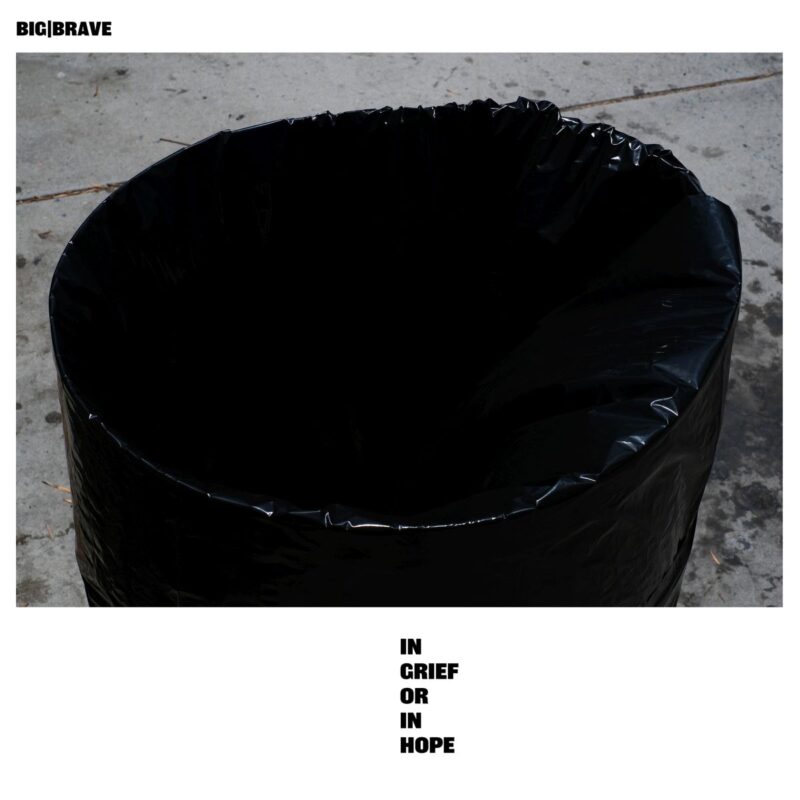
BIG|BRAVE bring an offering to this micro-genre: in grief or in hope. With longtime drummer Tasy Hudson taking a break from the band to pursue some of her other projects, the band saw an opportunity to keep moving and create something new. On this record, founding members Robin Wattie and Mat Ball wield guitars and amplifiers to create BIG|BRAVE’s now famous soundscapes, and Liam Andrews, who has been rounding out their live band with bass for several years, becomes a full-time member. The album is still entirely functional as a BIG|BRAVE record – this isn’t an ‘acoustic’ or ‘unplugged’, nor a side project or after thought. This is their massive sound taken to its epitome.
It would be easy to talk about what’s not present – drums, for starters, but also Mat Ball’s classic guitar noodles, and the huge ranges in dynamics that could be found on the band’s epics. But this would leave in grief or in hope sounding bereft, and it’s anything but. Each track has its own swaths of drone and stuttering feedback, rendered in a way that balances patiently planned compositions against live improvisation. At the same time, the band has found new levels of melody within the heft. Working to contain all of these contrasts is Seth Manchester, who has been BIG|BRAVE’s go-to engineer for many years (since 2019’s A Gaze Among Them). Even as their sound has changed across nature morte, A Chaos Of Flowers, OST, and now in grief or in hope, Manchester has imparted a consistent and high fidelity sound to the project.
The increased focus on vocals and lyrics encountered on A Chaos Of Flowers transfers directly into in grief or in hope. Wattie’s vocals also find renewed purpose in making these dronescapes navigable. There’s increased focus on memorable melodies, and possibly unusually for BIG|BRAVE, these come in cycles that resemble verses and choruses. At times, it’s as if they’ve reverse engineered ‘pop’ structures by digging away deep at the other end of the spectrum. Lyrically, the record is as poetic as A Chaos Of Flowers, weighing the extremes of the human experience.
Individually the tracks are highly memorable and have different intentions. “a shape of shame” incorporates dry acoustic strums, peaking above the noise before being subsumed, whilst Wattie wavers between humming and screaming. “the ineptitude for mutual discernment” typifies the album, where the guitars rattle the entire sonic spectrum, leaving only room for the shrill fuzz that comes at the edges, like smoke trying every path to find the one escape route to freedom. Wattie’s voice is soft above this sharp fog in a style that also emerges on “skin ripper”, a piece that begins welcoming and ends frigid, layering the drones over and over again.
“holding tongue” is a distinct fingerprint of modern BIG|BRAVE – a truly soft interlude that bridges the gap between the LP’s two sides, where the distortion abates and the amplifiers get a little breathing room. The low register is vacated for a plodding bassline that is altogether ambiguous yet welcoming. As usual, despite having simpler intentions, the track is one of the record’s high points. Knowing the bass hasn’t been exercised for a precious moment, “verdure” kicks in with a disgusting loop. It somehow resembles a synth with its cyclic nature and pulsing character, but as it loops, it becomes more like a fumbled guitar cable; a mistake that’s become canonical. Wattie is safe to sing away until the third minute where she’s enveloped by a wall of harsh noise, its source so clouded that it hardly resembles a guitar. The imposing industrial mood of “verdure” resembles that of The Body and Dis Fig’s collaborative record in 2024 (another Thrill Jockey–Seth Manchester modern classic).
“an uttering of antipathy” carries an air of finality to it, with its urgent semi-riffs and vocoded vocals. The title track follows to provide a true end to the record, perhaps a surprise given the prior track’s power. The drones the band creates are more subdued – somehow quantifiable now that you’ve made the journey through the album – and a sobered Wattie provides the record’s lyrical punchline (“when does one feel the most / is it in grief or is it in hope?”)
BIG|BRAVE have kept a busy release schedule for their entire existence. Those of us who remember the buzz when Au De La found its way into the noise-nerd airwaves can take a rewarding look back on a deep discography. in grief or in hope’s left-field approach means it likely won’t be considered the band’s defining record, but regardless of your familiarity with the band, it must be examined in detail. It’s an example where the source of the spark doesn’t matter; whether a creative act or logistical fallout, embracing and moving with change is often the correct move in artistic endeavours. As a singular experience it’s possibly unmatched, in their catalogue and beyond, being crushing and meditative at once in a way we don’t hear often enough.