
“Breathe in the deafening glow.“
Welcome to In Conversation, our interview column where we chat to our favourite artists who are producing incredible music. For the second of our interviews undertaken at ArcTanGent, Dobbin sat down with of REZN who are defining the cutting edge of doom. We chatted to Rob McWilliams (guitar and vocals) and Spencer Ouellette (saxophone, synthesizer and more) about their recent tours and release of their most recent records, Solace and Burden, plus an in-depth dive into a certain special influence.
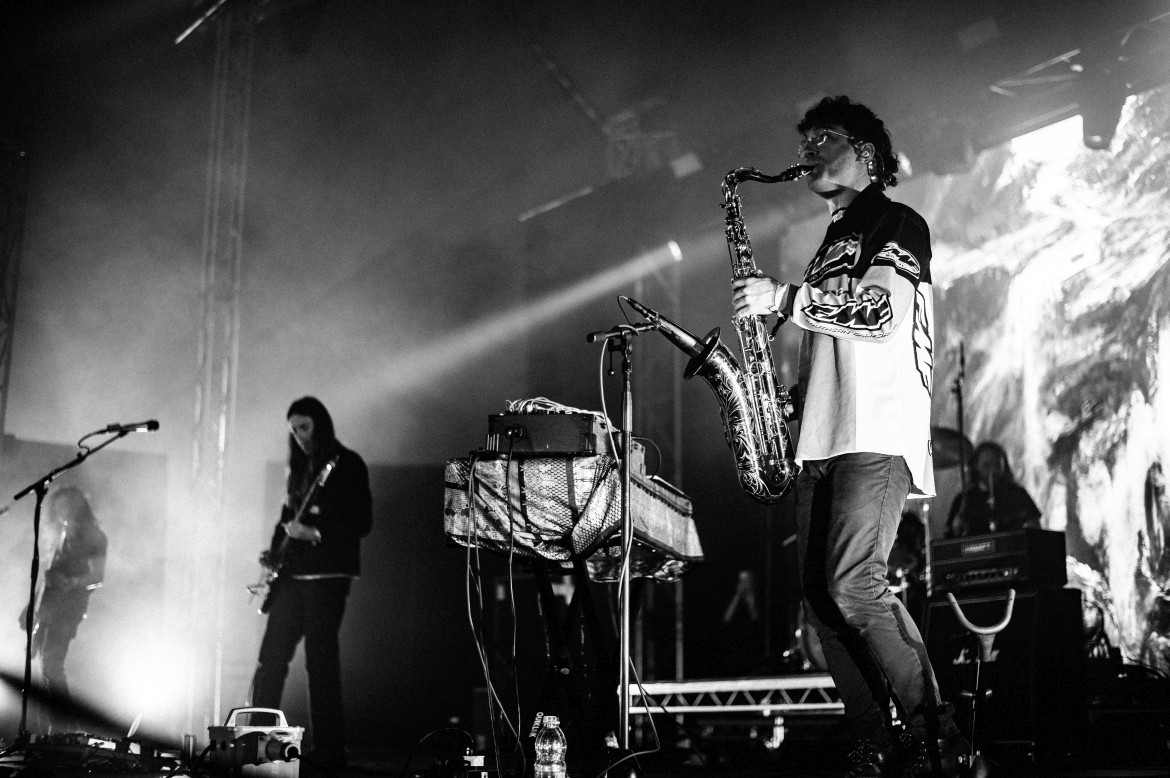
Photography by Kieran White – contact Kieran prior to any use.
Powered by RedCircle
Spotify feed here.


Dobbin: Welcome back to the UK! I was really excited to see you on this year’s ArcTanGent. You’ve been here several times with a few different bands, and a few sets just before this. How has tour been going?
Rob: It’s been good, this is our first headliner out here. We’ve gotten a taste of it before – we did a bigger your with Russian Circles in November which got our feet wet. Now we’re going for it, seeing how we do on our own. It’s been really nice! It’s cool to see people that are there for you, and to be able to curate a show and play for an hour.
Dobbin: Birmingham I want to home in on, in the wider context of Ozzy passing away, and Birmingham was the centre for all of that. Did you get a chance to pay your respects?
Rob: Dude, that was the only thing we’ve been able to do! We got to Birmingham after a two hour journey, checked into the hotel, and had a moment to walk around. From the venue, The Flapper, it’s eight minutes to the Black Sabbath bridge. We went over and were super grateful to check it out. It wasn’t as lavish as the pictures we saw a few weeks ago where it was full of stuff, now it’s more modest. We saw some people there also there to pay their respects – literally kissing Ozzy on the mouth! Really funny, but really sweet, showing how touching it is to everyone. The show had the most rowdy crowd, and hopefully that’s due to them being stoked on this music, being at the epicentre of this style. Super glad that we did that, the rest of the tour has been kinda hectic.
Dobbin: Let’s talk about studio stuff – one move that REZN took was to record Solace and Burden in basically the same sessions. From my perspective, it set you up so well, it’s such a smart stragergy when you’ve got all the material ready. It also means maybe you haven’t been back to the studio in a long time. How did those sessions go for you, and how do you feel about both those records now?
Spencer: Doing them back to back was part of the plan. We weren’t really sure about the release strategy. At first, we thought about dropping them together, even a couple of weeks apart. It was naturally divided into two parts by the themes; there’s a lot of options there. We released Solace initially on our own, and then before we had release Burden we were picked up by Sargent House. They advised us to wait for an album cycle, and that was definitely the healthiest thing to do. Whilst we’ve heard this music so many times, and the idea of getting them all out is so exiting, especially doing a tight release schedule. But Sargent House knew that people would need time to process what we’d release. In the end it worked out well; we can now spend some time just focusing on one of the records, playing more of the Burden stuff and sprinkle in the Solace stuff, and lay the groundwork for future records. We’re still very happy with the records and the way the recording and releases went. The month gap between recordings helped nail down the consistency between the two. They’re still sister records even thought they were released about a year apart.


Dobbin: A theme with your records over the years is a connection to nature, and a specific locale. I only realised this quite late, but it makes them all fall into place. Let It Burn was this feeling of space, being barren and desolate, perhaps volcanic. Calm Back Water is about deep, deep oceans. Chaotic Divine was endless deserts with an alien motif. Solace was mountains; but I wasn’t able to find somewhere telling me what Burden was. For me, my guess is rivers; we see a river of water but also a river of magma on the cover. What’s my grade?
Rob: A-, because you are predicting our mindset! We talk about rivers on the next one. Burden, in my mind, is the cave. The art doesn’t always depict the scene correctly, at least in our minds, but it does fit the description of the album. I need to go back and listen to it, thinking of rivers. We wanted to put all of the lighter, more airy atmospheric songs into Solace, the ones that swept you upwards emotionally. On Burden we’re trying to do the opposite – compress you, twist you, wind you into this claustrophobic feeling. Not to punish you, but to give you that dichotomy, and also to showcase all these heavier songs with more dissonance and intensity compared to Solace. We’re talking about new places to explore, and rivers is coming out on top, because there’s so many ways to do it. The natural world shows you where to go, in a way, and you can twist it a little bit later, such as adding a sci-fi element.
Dobbin: Can we be even more specific – are there any mountains or caves that provided a point of inspiration? America has such a fantastic landscape.
Spencer: I won’t divulge as to whether there were any specifics in mind. But the question was more like, what is that oppressive cave to you? What peak are you trying to climb? I don’t want to sound pretentious, but it’s gotta be vague.
Rob: Solace and Burden were leaning into being more emotional with a first person point of you, rather than third person describing a bunch of scenery. This time it wasn’t painting a picture, it was telling a story. I think that is a shift in the writing. Now we’re getting more vague visually, whereas before it was very much a tool to guide us whilst we’re writing. Now we ask, what do we want to convey? And it doesn’t have to fall into a certain world or biome. It’s fun; it’s new territory, you can write whatever you want, and people will describe it in their own way, which is the best part.


Dobbin: That’s one of the fantastic things about music. A mountain doesn’t have a sound, but that doesn’t mean we don’t make a link. Sound makes an aesthetic link in interesting ways. The art direction you have is of course fantastic, but there’s no “Mountain riff”… and yet, there is a “mountain riff” – you know it when you hear it, right?
Rob: That’s right. It’s open to interpretation, which is what we’re trying to shift towards. It’s more of an abstract idea, and everyone can experience it differently each time.
Dobbin: Stepping through the back catalogue, I wanted to talk about a lesser known release – Infected Ambient Works – I’m particularly happy to get to chat to Spencer, because I imagine this is mostly your brainchild, as you also have solo electronic records. I’d like to know a bit about the origin of the album, I listened to that thing loads across 2020 when it dropped, and in 2021 especially.
Spencer: You know, COVID was happening, it is happening still, but during the lockdown just like anyone else making music, we were very concerned with that we would do with that time. I wanna say when the lockdown in the US started, we were only just kind of starting to think about writing Solace and Burden. We were practically the only people we were spending time with, so we would get into our space and mess around with ideas, but there’s plenty of chapters of the lockdown where meeting even each other was not possible. We just wanted to be productive whilst being stuck in our own corners of our homes, making whatever we can musically. We started sharing little nuggets of ideas with one another that we wouldn’t consider remotely ‘standard REZN’ ideas. We though, we should patch these all up together, and make something cohesive, and put our time somewhere, even if we’re not able to get together and write “rock music”. I spearheaded the patchwork aspect.
Dobbin: It really does come together as a nice continuous piece. When I hear albums like this, I like to take my favourite choice moments and playlist them, because I love ambient music. But it was really hard to do that for this one, because it was so interconnected. It’s really cool you took the time to do it, especially because Blood Incantation, a year later, discovered the synthesiser, and came along with Timewave Zero – but I wanna say you got there first.
Rob: I wanna say they got there first, and kept quiet about it! Since the start of the band the way that Spencer has incorporated the synthesiser has evolved and become very organic. We didn’t even mean for it to become so important, but now it’s become a tool for expressing those soundscapes, accessing insane sounds you can’t get from a guitar. It would be very easy to have two guitars, but the fact that we don’t creates new challenges and new limitations so that we can fill the space with new ideas that Spencer can only fill.
Dobbin: I watched another interview with your bassist Phil Cangelosi, and he said Spencer is a massive Autechre fan. They started weird, and got even weirder; tell me what your favourite Autechre releases are.
Spencer: I can’t even believe he said that. I can’t believe this is happening right now. This is the greatest moment of my life! I am a massive Autechre fan. I never talk about them with anyone because I’m too afraid. My favourite Autechrge record, it changes constantly, and that’s why I love them so much. There’s always so much to discover with their music. For a long time, it was LP5, and then it was Quaristice – I don’t even know how to say it, because I’ve never talked to anyone before! But the one I return to the most is probably Exai; the densest, most incredible balance of complexity and ideas that are still so innately musical somehow, if you give it the time. When people listen to it for the first time, especially Autechre’s later stuff, it can be a real challenge. Not even because it’s “hard” music to listen to, it’s just unusual, the first impression is chaos and computer music. But if you give it a minute, you find yourself bobbin your head… You realise they’re obsessed with hip hop. When you snap into that mode, you realise how novel it is. Last night we were talking, at least in my opinion, one of the most fun things about music is the feeling of discovery – you feel like you’re unpacking something. It’s why it’s important to keep music abstract on some level, so it’s up for interpretation on some level. Autechre makes me feel like the music is ‘mine’, it’s my own journey. As a synth guy, it’s fun to have something that is in that world that is removed enough to still have a veil of mystery around it; innately musical.


Check out the full audio for more details, including a deeper dive into some of Spencer’s gear tricks.