
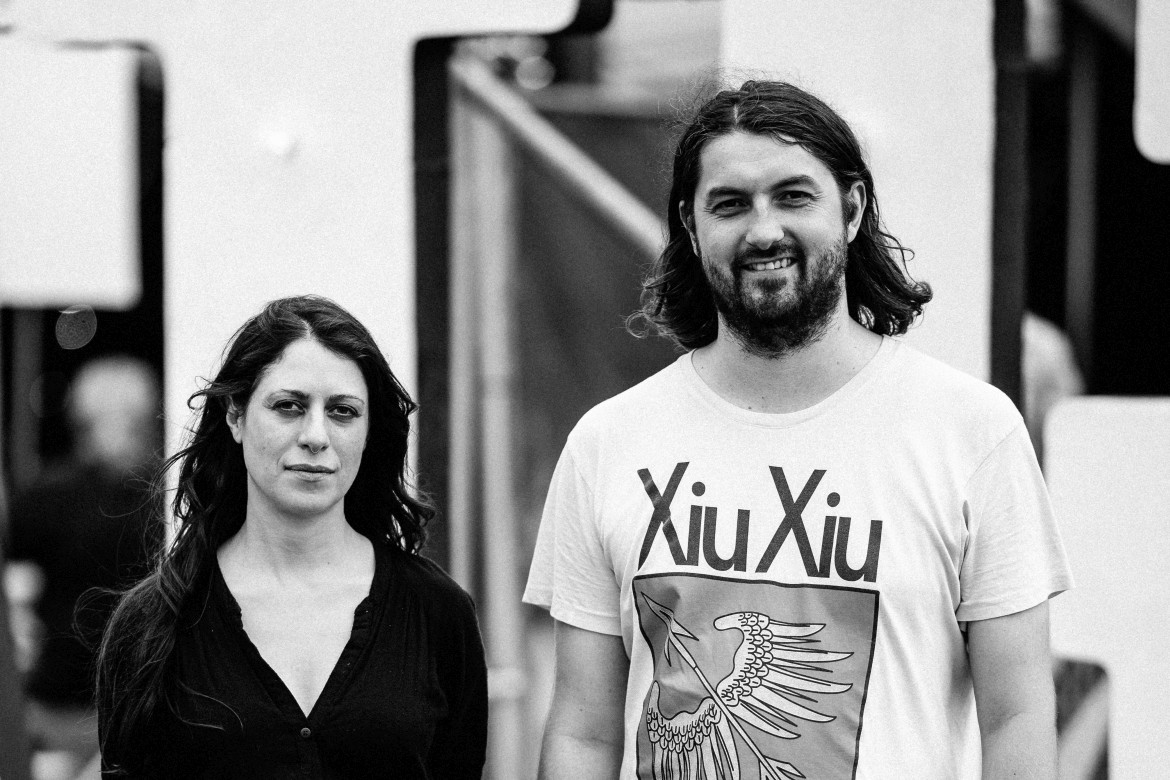
Welcome to In Conversation, our interview column where we pick the brains of artists on the cutting edge of music. Dobbin had the opportunity to chat to Amaya López-Carromero and Scott McLean, following live shows and key releases from both Maud the Moth and Healthyliving. Recorded at ArcTanGent 2025, this chat delves into all aspects of these projects, especially the approach to recording and the meaning behind The Distaff, and how Healthyliving fits into their musical world. Photography by Kieran White – contact Kieran prior to image use.
Due to audio issues in the second half of our discussion, just the first half of the interview is included in the recording below. The write-up contains all the missing parts, plus the audio has some additional details on tension and resolution in Maud the Moth‘s music, and on Amaya’s favourite support slots.
Powered by RedCircle
Spotify feed here.


Dobbin: You’re celebrating the release of The Distaff, which dropped earlier this year. How did the release go?
Amaya: I was quite overwhelmed. This is the first time I’ve done an album with a considerable amount of help around me, from the PR team to the people doing the pressings, so it wasn’t a super ‘DIY’ effort like some of the other ones. As a result, it reached a lot more people. It was really incredible how many people connected with it. I was really proud and humbled, and found it quite emotional. It’s a very autobiographical, personal project that I do to cope with life and the topics are, not necessarily dark, but very, very deep. It’s probably not meant to be so public, so when it has a higher reach than you’re used to, it’s a bit difficult to deal with. I was a bit fried for a couple of months after the album came out! But I’m super, super happy that it connected with so many people, I’ve had so many beautiful messages from people; it means a lot.
Dobbin: I love this album, it’s immediately memorable and really varied, whilst the songs take the same focused sounds and textures. It’s a bit of a different album for the project, yet it’s in line with the weird worlds that you create. Take me through the process of building up these songs.
Amaya: For Maud the Moth my ideas form a bit like a seed. Some take to the soil and others don’t. Sometimes when one idea becomes really overpowering, it demands this very intense attention, and it ends up coalescing into a song. I don’t know how I’d describe it – there comes a moment of space and time, that exists out of reality. On this album in particular, I wrote for piano and voice at the same time. On other albums I focused more on the structure of the song, but here it was always about the raw emotion and the arc of a song. There’s a quote by Maria Callas that I really love – “In an aria, there’s just one long breath” – I think it was very inspired by that kind of leader tradition that I had as part of my classical training. It’s a collection of songs, and there was a strong process at the end that made it into a unit which worked really well, I worked with Scott on this a lot. They were connected emotionally, when writing each of the songs I was focusing on each of the little seeds.


Scott: From my perspective as a producer, one thing I noticed with Amaya’s previous records is that I don’t think they sound like her live performances. It was very important that the new album captured that live feeling. If the song worked with Amaya and the piano, then we could add on the other stuff. There were lots of additional arrangements when we got to it, and we were only adding what was necessary. Even though the album sounds very grand, there isn’t very much going on – sometimes we added a synth bass to make the piano sound bigger, for example. It was about letting the songs exist first and then adding to them to create the world that Amaya usually inhibits with Maud the Moth, rather than starting off that world with the song in it.
Dobbin: You can tell that the piano works as the scaffolding of the album, and at times it’s like something has completely overgrown over it, yet it remains the connecting thread. A big part of the soundscape on The Distaff is the guitar, which we haven’t heard in the same way in Maud the Moth’s discography. On “Exuviae” I love the soundscapes of birdsong and sheet metal, and on “Despeñaperros” the strings and the delays at the end of the song are incredible. How did you decide which pieces needed what kind of sounds?
Amaya: A lot of it comes from the songs themselves. “Despeñaperros” is very long, so it calls for a greater dynamic and textural variation. You can see it like a hike up a mountain, like you’re conquering something; it traverses a lot of landscapes, whereas the other songs are like a little postcard – “Exuviae” is very static, a moment frozen in time.
Scott: Stuff was only there if it made it better. There was never ‘always a guitar’ if the piano and voice work on their own. The sheet metal sounds are actually bowed cymbals. For the sound world on “Exuviae”, Amaya spoke to me about an image of a ‘green gate’, so it should have an image of a garden, so those cymbals are there to sound like a gate opening. Amaya would give me a lot of visual references. The last track, “Kwisatz Haderach”, is a lot more ‘space’, ‘cosmic’ and ‘sci-fi’, and that informs the way we’d make the arrangements. If it’s not working, you just keep trying. The arrangement for “Despeñaperros” is one that we became happy with it three days before we took the album to mastering, as it wasn’t having the emotional impact that is contained within the piano and voice. We would just keep on working and trying new things.
Dobbin: I understand the record was inspired by Spanish landscapes?
Amaya: The album is a reflection on what gets passed down – a dowry, or heirloom. What gets passed down is often intangible: memories, expectations, culture. And it’s about what society expects of the individual, you’re in this constant state of reclaiming your individuality and expression, who you feel you are. This is all narrated through flashbacks and broken memories from childhood. Even broken memories passed down from my parents, who lived in post-war Spain through the Franco years. I can’t imagine what it’s like to live through that situation, and it leaves a massive mark and a trauma that gets passed down. I feel it’s very idiosyncratic to Spain.
Most of my life was spent in rural parts of Spain. I was born and lived in Madrid, and some of my early albums focus on the liminal space between the city and the wasteland and fields outside. London has these as well, ‘rave’ territory – which I find very magical and inspirational in a way. Some random person wrote on RateYourMusic, “a neoclassical approach fit for the 2020s”, and I took that as one of the biggest compliments in my life, because I do feel very inspired by neoclassical artists like Dead Can Dance. I try to inform it with my own lived experience.
Dobbin: A few questions about Healthyliving. You’ve just finished performing that set at ArcTanGent, which got a warm response, how did it go?
Scott: It was a fun set, it’s always a bit of a blur, but I had fun playing guitar! With Healthyliving it’s a bit weird, as we have nine songs – we need a few more!
Dobbin: The album is two years old, how has your perception around it changed with time? Are there any songs that have risen or fallen as personal favourites.
Scott: I actually don’t think it’s changed at all. There’s one song which I don’t particularly enjoy playing live. I’m not gonna say, so that I don’t ruin it for others! And there’s one song that I really love playing live, “Back to Back”, it’s one of my favourites. I’m pretty much completely happy with the album – it’s one of the things that I’ve worked on that I’ve been most ‘sure of’.

Amaya: I really, really enjoy playing Healthyliving live. I’ve started playing bass now, this was the second show. It’s terrifying, but it’s also really fun, and it means the band feels a lot more locked-in together. This is how we always intended things to go. Scott and I started the band after knowing each other for a long time, deciding to make some songs together, and call it ‘healthy living’ because it will be the ‘chill’ band that we’ve never managed to have. For me, it was intended from to heal from the fact that I always wanted to have a rock, punk, or metal-adjacent band. When I was growing up, I was often the only woman in the rehearsal spaces, and I was mocked or discouraged from playing guitar or making my songs more aggressive. For me, it was a form of healing and empowerment. Despite starting a chill band, suddenly our first show was Roadburn, and things did not get more relaxed! With the band we’ve been able to get amazing opportunities which we are grateful for, but it would also be great to grow it in front of audiences of less than a thousand people!
Dobbin: Your bass brought a fantastic low end to it, I loved the break-up and pick crackle.
Amaya: We really wanted it to be gnarly, it was never meant to be super polished — Nirvana inspired!
Dobbin: “Galleries” was a big favourite when I listened to the record when it released. I think I got so swept up in it that I undervalued “To The Fields”, which I almost prefer more recently, with all of its weirder spaces and complexity. I didn’t expect it to be a live banger, but it works great in your set list.
Scott: I actually wish I saw more bands doing that, not always playing their loud ‘exiting’ stuff. I love playing “To The Fields” and the patience and space we create with it. It’s not about getting the crowd to sing along, I’m just not into that. Patience is a key part of Healthyliving.
Check out our coverage of these live sets at ArcTanGent here.