
‘We live in spite of you.’
Words by Kiera Falke. Photography by Kieran White. Please contact before any use.
The Joiners Arms is a special venue. It sits, nestled away, in perhaps the most unwelcoming part of Southampton. It’s an ancient, tiny pub that acts as a tonic to its hostile surroundings. The markers of massive artists from every genre imaginable cover every inch of wall and bar surface, chronicling the venue’s place in the history of diverse and offbeat music. Even among the near-endless catalogue of acts that have played in The Joiners, Conjurer’s show tonight feels particularly special. Joined by melancholic post-rock masters PIJN and frenetic Queercore duo Death Goals, Conjurer bring their signature brand of sludgy post-metal to this once-crumbling institution of the south’s underground music scene.
Death Goals


Opening the night is Death Goals, a bonafide pillar of the UK’s ever-burgeoning, never-mainstream Queercore scene. On the margins of hardcore and mathy noise, the duo delivers an adrenaline shot to a crowd still sleepy from the long days they’ve just been through. The edges of Death Goals’ sound are blurry, with the line between metal, hardcore, and mathcore becoming ever more obfuscated over the course of their 30 minute set. The band’s lyrics also deal with a refusal to be pinned down or categorised into neat boxes. Screamed, dissonant ragers are segmented by calls to actions for queer rights, remembrances of trans lives lost to individual and systemic violence, and reminders that those who disagree with the ongoing fight for queer liberation can ‘get the fuck out’ of the building.
Vocalist/guitarist Harry Bailey is unabashed, unapologetic, and proud. Death Goals’ entire aesthetic is flooded with Harry’s refusal to apologise for who they are. The infamous pink triangle, originally used to identify gay victims in nazi concentration camps, adorns the band’s drum kit, as well as their stage wear and merch. No cheap act of shock horror, Harry and drummer George Milner wear the triangle as the ultimate act of reclamation and self-determination, a raw reminder that being unashamedly yourself is an act in defiance of crushing conformity.
The set is frenetic, with far more noise than should be possible to come out of just two people. Mosh pit privileges are cheekily handed out and revoked by the band, before vocalist Harry sets a dissonant riff to loop on their guitar, throws it to the ground as it continues to beam noise, and jumps down into the crowd. The set comes to a close with the same dissonant riff crushing the ears as Harry screams in the audience’s faces, equal parts moshing and sexy dancing their way around an ever-filling floor.
PIJN


Just as the audience are starting to come down from Death Goals’ blistering set, Pijn take to the stage. No venue lights are left on, the only illumination in the room handled by four tiny lamps, which cast a sepia filter across the band and audience. ‘Our Endless Hours’ kicks off the set. Its opening sample is a single spoken sentence: ‘each day, time drops a tiny death at your door.’ Between the minimal lighting and stark opening statement, the mood is well and truly set. Pijn is a band of patience, introspection, and stark melancholy, and their live show reflects this perfectly. Lonely, reflective instrumentals build up seemingly endlessly, forming waves which crash to earth with heavy climaxes that feel monumental after multiple minutes of thoughtful build-up. The audience is completely silent when not applauding at the end of songs.
There’s a concept in art critique called ‘art as a mirror’, the idea being that great art can prompt you to look inwards at yourself, rather than at the intentions of the artist who made it. Pijn, as a live experience, is the perfect example of this. The ponderous instrumental ambiguity of the music invites you to look upon its blurry canvas, and fill in the cracks in its meaning with your own thoughts, emotions, and experiences. In this way, Pijn is a different band entirely for every person in The Joiners, each projecting their own internalities out onto the four musicians on stage.
Conjurer


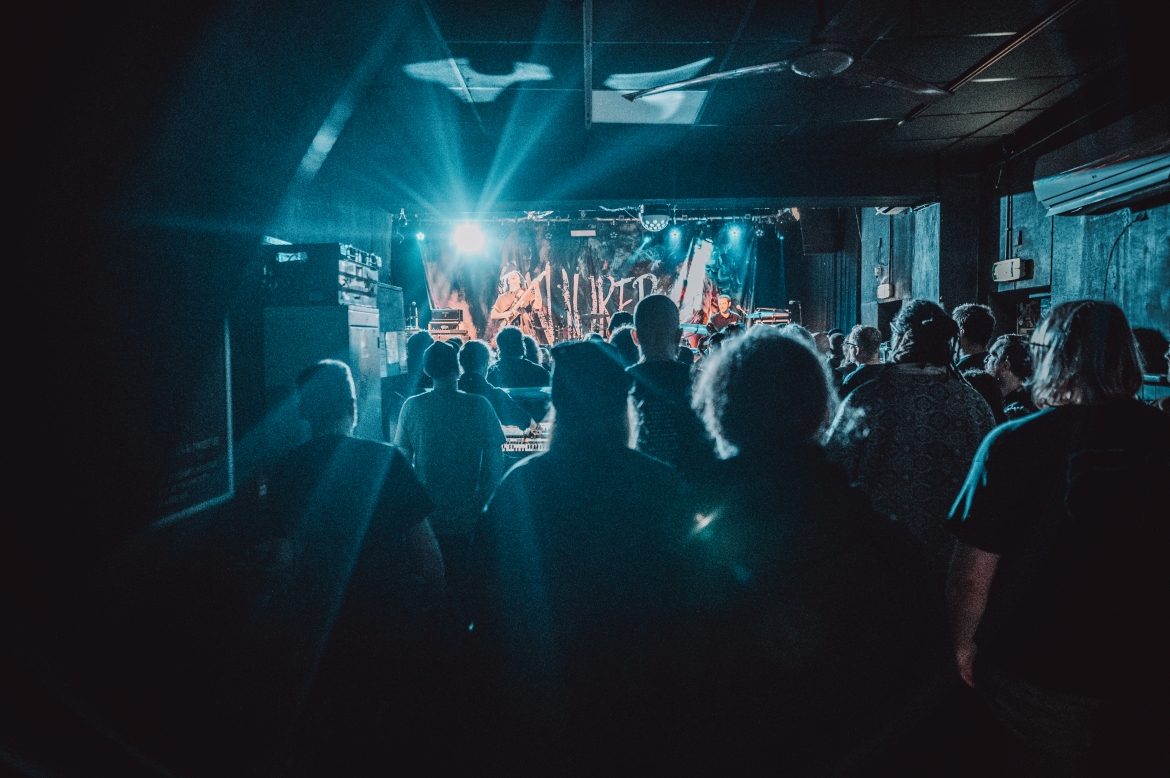
By the time Conjurer takes to the stage, the room is absolutely packed. As Dani Nightingale and co. arrive, the first thing that strikes the audience is just how perfect they sound. Every guitar riff, drum hit, and lyric is delivered with studio-level precision, while maintaining the emotion and intention of an incredible live act. It’s hard not to be floored by the gravity of the band’s presence as opener ‘Unself’ turns from solemn to scorching. A stunned audience sings and prepares themselves for the heavier bangers yet to come, and come they do. ‘Choke’ and ‘Retch’ are brought out to thunderous movement from the crowd, the centre of the floor turning from a safe area into a warzone.
Somehow, the band loses no momentum whatsoever by swapping the violence for emotion, bringing out the cathartic, spiteful ‘Let Us Live’ to slow things down for a moment. Despite its slower, more melodic pace, the atmosphere in the room feels no less heavy. The anthem’s statement on the erosion of trans rights hits home for many queer folk across the audience. Where once was a pit stands a group of mesmerised eyes, struggling to stay dry. Of course, the moment the song ends, purposeful violence erupts yet again.
The marriage of crushing brutality and emotional catharsis is at the heart of what makes Conjurer special, and it’s on full display here tonight. Their set is thoughtfully constructed to maximise the impact of both sides of their sound, as well as the overlaps in which both are present. The show is finished with the band coming full circle, performing ‘The World is Not My Home’, a dissociative and crushing track that calls back to the beginning of the set. It’s hard to walk away from Conjurer’s set without a feeling of intense emotion, impossible to pin down. Joy, sorrow, catharsis, mournfulness, alienation and togetherness are all present there in the room, refusing to untangle from one another.

On first glance, this lineup is a strange one; the three bands sound very little alike, and on the surface they wouldn’t seem to share a fanbase, either. The connection that I had missed, however, is just how beautifully queer the fanbases of these three bands are. Linked through circumstances outside of the three disparate acts on the lineup, the outsiders of Southampton and its surrounding towns descend upon The Joiners. The result is a largely packed room, filled with the most unashamedly queer crowd I’ve ever seen in this tiny southern city. In a time when gay rights are at increased risk, and trans rights are being actively eroded throughout the developed world, nights like this aren’t just a great time listening to metal. They’re important. This country, this city, this neighbourhood are scary places to be visibly queer. But here in this building, with this lineup, the world is a bright place.